
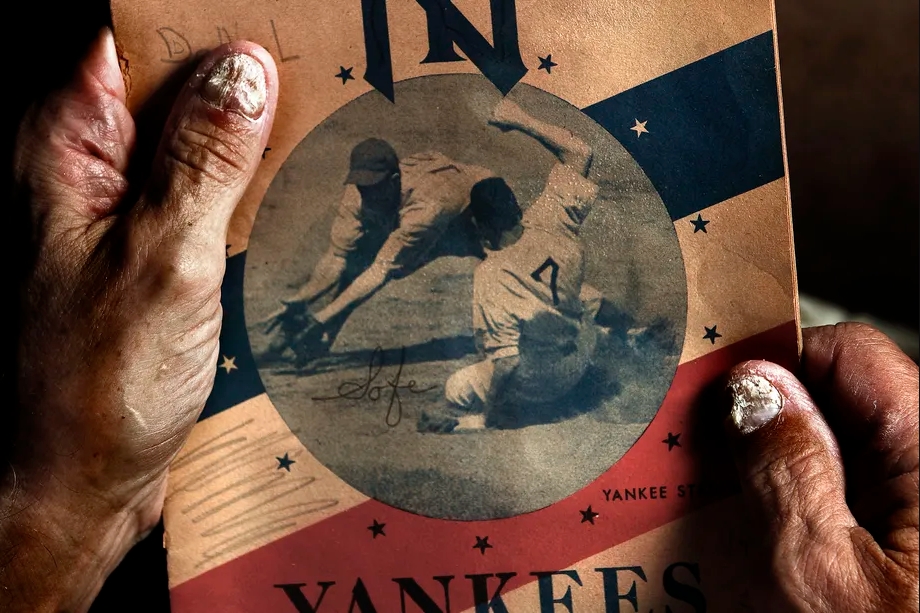
After spending eight years out of the big leagues, one Yankee backup catcher put in a performance out of nowhere.
If you take a list of every Yankees player who ever stepped to the plate, restricted it to just the guys who had more than 100 plate appearances, and then sorted it starting with the worst OPS+, you’ll find a lot of pitchers to start. That makes sense, as even before the DH came into existence—rendering it mostly useless for Yankees’ pitchers to hone than part of their game—it’s not as if pitchers were especially great hitters. Sure, there were the Red Ruffings of the world, but on averages, pitchers have always been pretty bad hitters.
Therefore, if you were a position player who ended up mixed in at the bottom of the worst OPS+ with 100 or more plate appearances, you really struggled. Herb Crompton is one of those players, with a 23 OPS+ in 104 plate appearances in his one season as a Yankee. However, there was one day where he shined at the plate, and him ended up a Bronx Bomber is notable on its own.
Born in Illinois in 1911, Crompton first shows up in Baseball Reference databases as a member of the 1934 Fargo-Moorhead Twins, putting up a .332 batting average in over 100 games as a catcher. His play in the minors eventually led him to be picked up by the Washington Senators, for whom he appeared in two games for in 1937, recording one hit.
Crompton returned to their minor league system, but never made it back to the majors, eventually joining the White Sox organization in 1942. Later that year, he was selected by the Pirates in the Rule 5 Draft, but it was increasingly starting to look like he would never return to the big leagues. It wasn’t as if he was struggling those years, notably hitting .339 in 141 games in 1940. However, as the years kept going without a recall, Crompton even started to do some work as a player/coach while continuing his time in the minors.
In November 1944, Crompton again moved organizations as the Yankees selected him in the Rule 5 Draft. If you know your history, there was something major happening around then by the name of World War II. Several players were away serving in the military, including Yankees catcher Bill Dickey. With the Yankees likely just needing bodies, the acquired the 33-yeard old Crompton and brought him in as the backup catcher, eight years after he had last played in the majors.
As you might expect for the backup catcher long missing from the majors and acquired while the league was down some talent, Crompton did not exactly light it up at the plate. Through May 20th, he was hitting .135/.158/.162.
Two days later, Crompton was in the starting lineup as the Yankees hosted the Philadelphia Athletics. The game was notable for being the first ever twilight game, starting at 5:45 PM. When he stepped to the plate with two outs and two on in the second inning, you’d have been forgiven for not thinking much would come of that. However, Crompton hit one back to the pitcher Steve Gerkin. Nothing else in the box score or the New York Times article about the game further explains what happened other than listing it as a “single.” Either way, two runs scored on the play, giving the Yankees the lead.
Two innings later, with runners on the corners, Crompton again stepped to this plate. This time, he hit a single of a more normal variety, scoring Oscar Grimes. Those three RBI from Crompton ended up being the only ones scored by either team, as Yankee pitchers Hank Borowy and Jim Turner combined to shutout the A’s.
In finishing with a final season stat line of .192/.208/.222, Crompton’s two hits on the day represented 10 percent of the 19 he had in 104 plate appearances on the season. His three RBI were a quarter of the 12 he put up in ‘45. Without those two hits, Crompton would’ve hit .172/.183/.202. Not that a .430 OPS is that much better than .385, but that’s a big shift for one game for some who did get over 100 plate appearances that year. This game is a reminder that truly anything can happen in a one-game sample size of baseball.
Resources
https://www.baseball-reference.com/boxes/NYA/NYA194505220.shtml
https://www.baseball-reference.com/players/c/cromphe01.shtml
New York Times, May 23, 1945